Elementary-primary two-factor model using 2024-25 data. Corrected rebuild: 2026-09-10.
Oregon elementary schools in communities with more college-educated adults tend to have higher test proficiency.
But schools also differ in the share of enrolled students experiencing poverty. This check asks whether
adult BA+ is merely a stand-in for student poverty, or whether both measures carry distinct information.
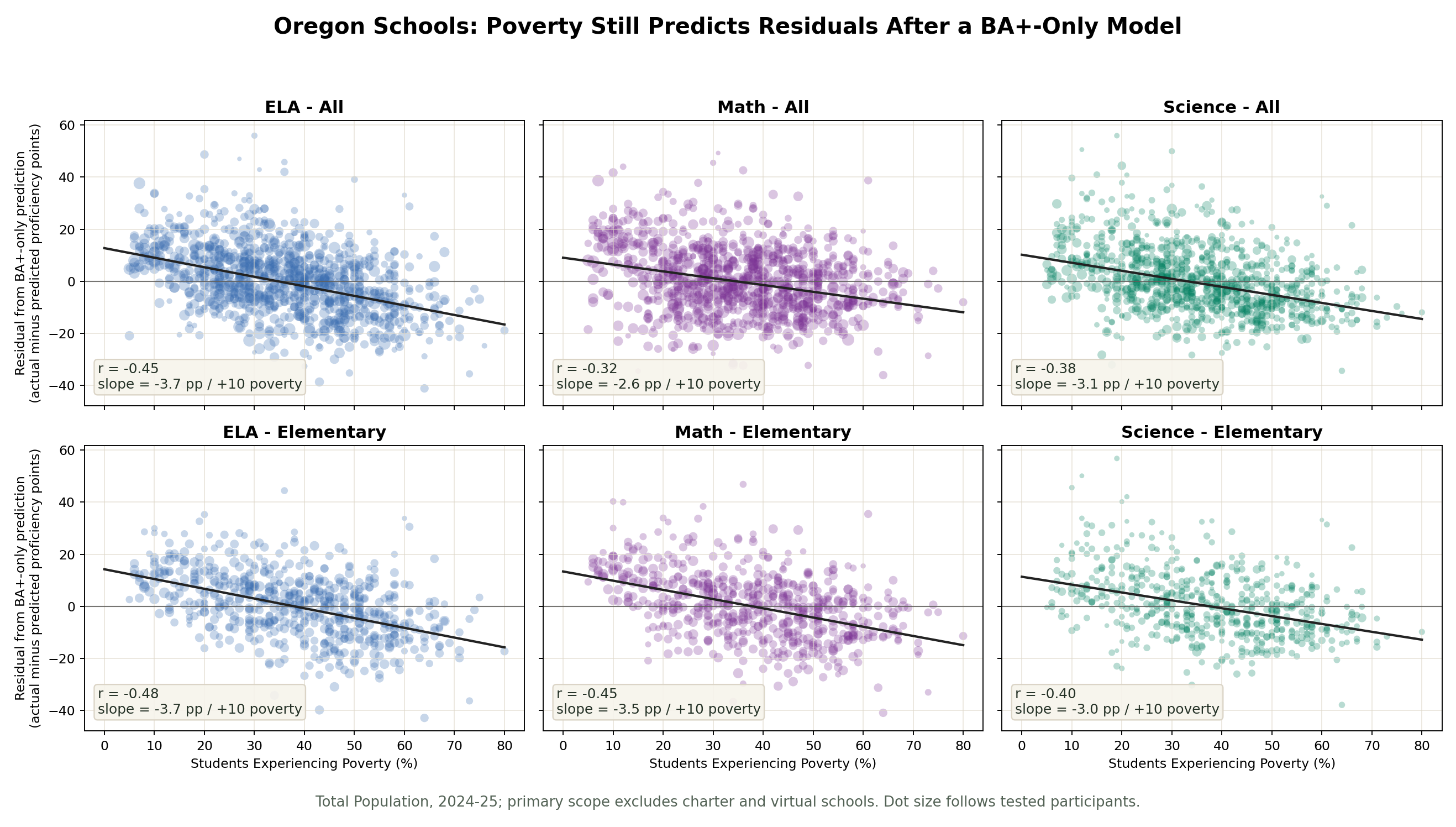
School poverty explains a large share of school-to-school proficiency differences in ELA, Math, and Science.
But adult BA+ does not disappear when student poverty is included in the same model. The cleaner reading is not
"BA+ is the single dominant factor." It is: adult BA+ is a strong community-context predictor, and school poverty
is a strong indicator of hardship among enrolled students. The two overlap, but neither fully replaces the other.
0.747Elementary ELA joint model R2 using BA+ and school poverty together.
0.719Elementary Math joint model R2.
0.646Elementary Science joint model R2.
What We Modeled
The model is intentionally simple: Percent Proficient is predicted from two variables, ACS adult BA+ rate and
ODE's school-sourced Students Experiencing Poverty measure. Elementary-only eligibility is classified first:
a school's combined observed ELA, Math, and Science tested-grade set must be nonempty and wholly within grades 3-5.
Each subject outcome then comes from that subject's single official Total Population All Grades row;
grade rows are never pooled. Outcomes and model weights use the exact
Scored Performance Denominator; complete Level 1-4 counts must sum to it and proficiency must
equal Level 3 plus Level 4. The primary view excludes charter, virtual, and schools identified by the ETL's
effective-dated special-enrollment policy overlay.
School-poverty disclosure status and bounds are validated. Exact values must equal both bounds. ODE inequality
disclosures such as <5% use their documented interval midpoint for computation (2.5% in that
example), require the retained original inequality token, and preserve the legal bounds. These midpoint values
are explicit working values, not exact observations.
What Each Measure Adds After the Other
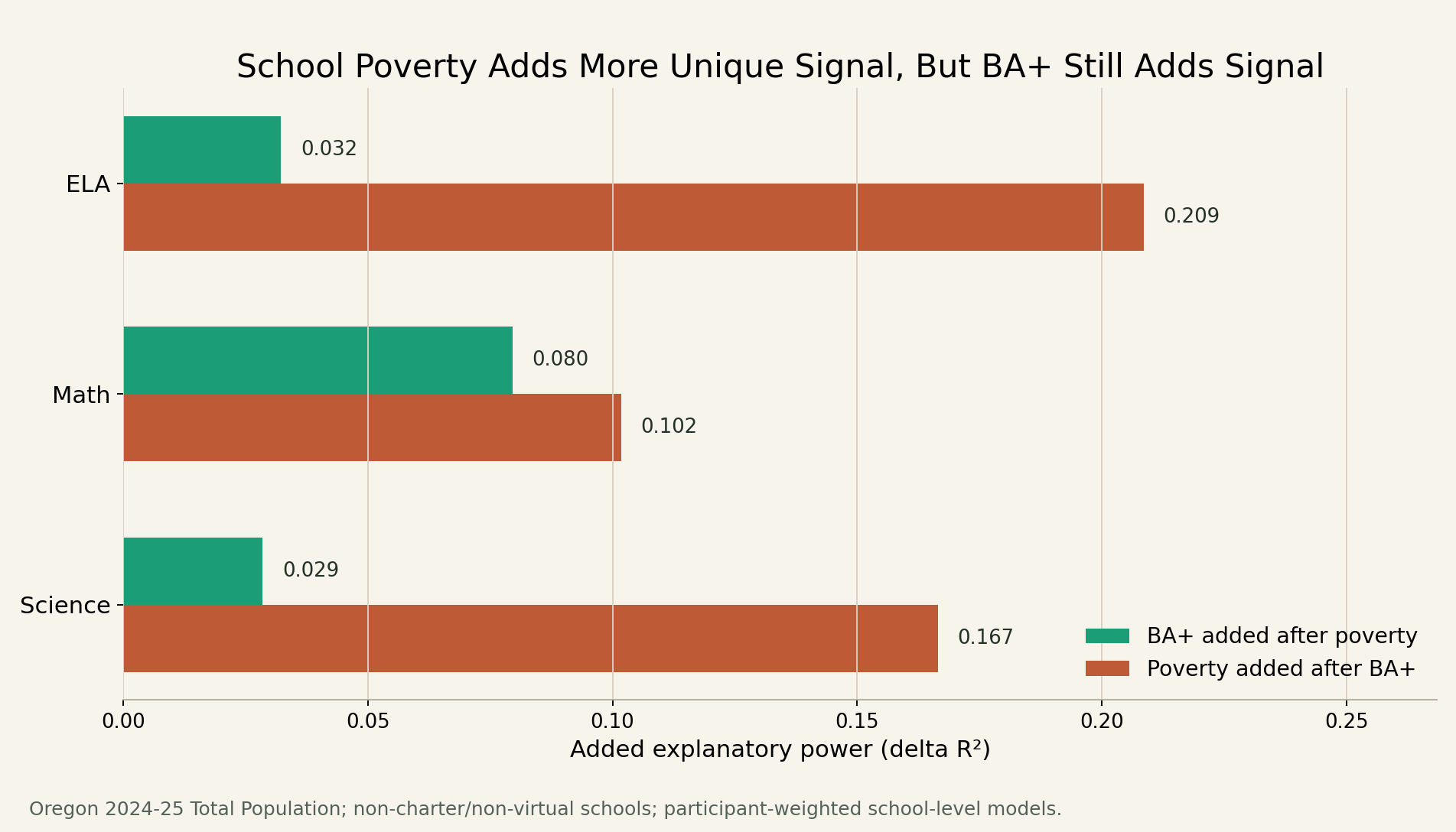
Added R2 measures how much explanatory power one variable contributes after the other is already in the model.
Poverty adds more explanatory power than BA+ in all three subjects. BA+ nevertheless remains meaningfully positive in each model.
Primary Results
Subject
Schools
BA+ r
Poverty r
Joint R2
BA+ beta
Poverty beta
BA+ added R2
Poverty added R2
ELA
468
0.733
-0.843
0.747
0.273
-0.649
0.037
0.211
Math
467
0.728
-0.822
0.719
0.294
-0.614
0.043
0.188
Science
437
0.702
-0.775
0.646
0.302
-0.560
0.045
0.153
Weaker-Geographic-Linkage Sensitivities
The earlier draft treated statewide All Grades results as primary. This correction makes
elementary grades primary because school-site tract SES is more plausibly linked to the enrolled population.
Official All Grades and pooled middle-grade models remain useful sensitivities, but their tract linkage is weaker.
Subject
Scope
Schools
Joint R2
BA+ added R2
Poverty added R2
ELA
All Grades
994
0.603
0.041
0.187
Math
All Grades
974
0.531
0.091
0.091
Science
All Grades
951
0.482
0.037
0.148
ELA
Grades 6-8
191
0.601
0.023
0.185
Math
Grades 6-8
190
0.706
0.048
0.177
Science
Grades 6-8
189
0.493
0.017
0.161
How to Read the Table
Correlation r is the simple weighted association before controls. BA+ is positive because higher BA+ is associated with higher proficiency. Poverty is negative because higher poverty is associated with lower proficiency.
Standardized beta compares each predictor on a common scale inside the same model. Larger absolute values indicate stronger unique association after the other predictor is held fixed.
Added R2 asks how much one measure improves the model after the other measure is already included.
Interpretation
In the elementary-primary analysis, adult BA+ remains a strong indicator of community educational context, but school poverty carries more
additional descriptive explanatory power in 2024-25 Oregon data. The right conclusion is not that one measure makes the other
irrelevant. It is that statewide performance patterns are better described with both: one broad
community-education measure and one enrolled-student hardship measure.
Caution: These are ecological, school-level observational associations, not causal estimates.
BA+ is attached to school geography rather than individual students or exact attendance areas. Students Experiencing
Poverty is closer to the enrolled school population, but it is still a school-level measure.
Related Evidence
SES explorations summary: a synthesis of income, education, poverty, and other SES proxy checks.
BA+ association in high-poverty schools: a descriptive banded analysis showing that the BA+ slope remains positive across the reported poverty bands; it does not supply a formal test of slope differences.
Why poverty can outpredict income: a plain-language explanation of why a school-population poverty field can outperform a tract-level income measure.
Income vs poverty reassessment: a poverty-aware model comparison using BA+, attendance, income, and Students Experiencing Poverty.